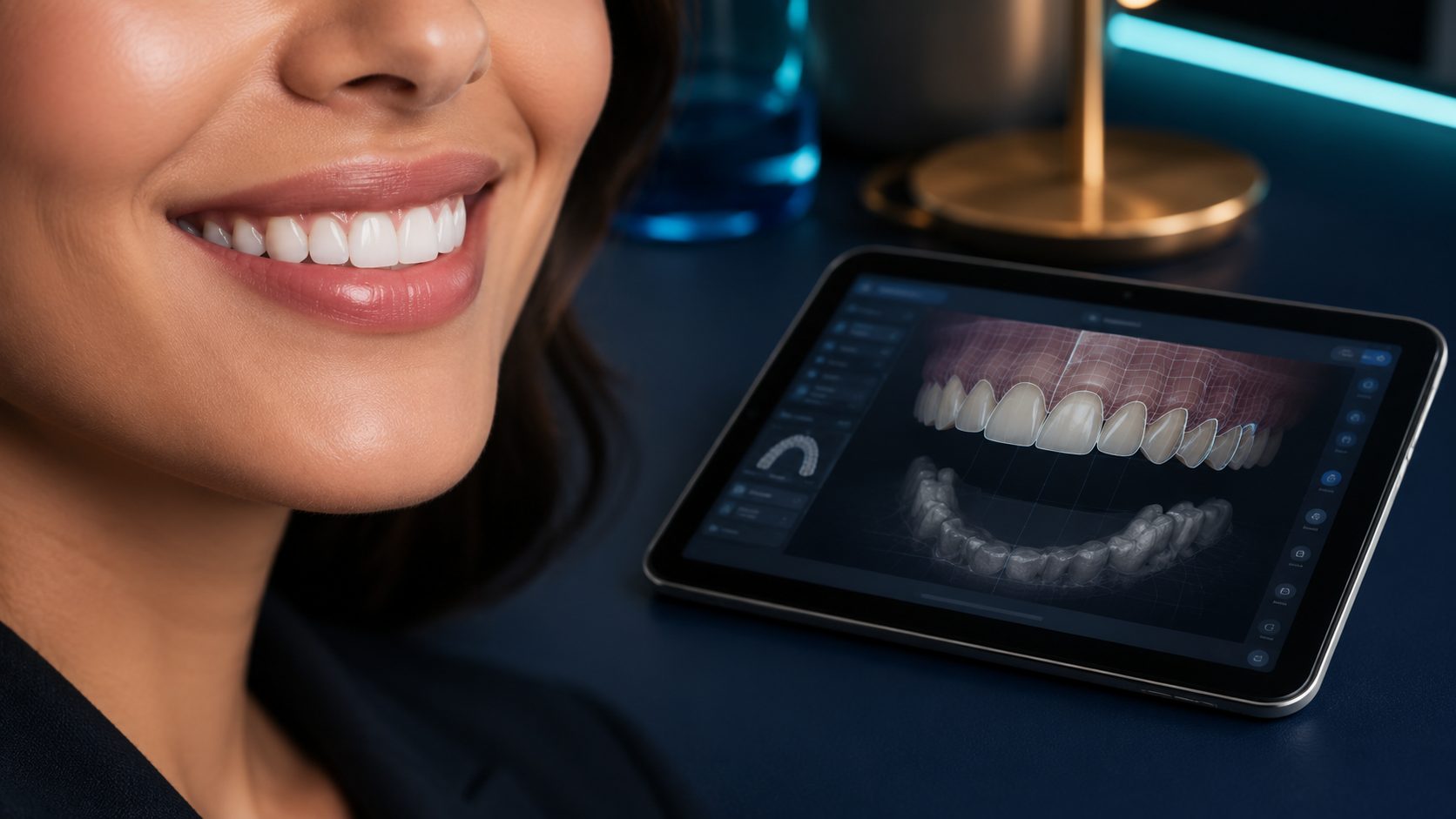
What is Digital Smile Design?
Digital Smile Design, commonly abbreviated as DSD, is a treatment-planning approach based on facial photographs, intraoral digital scans, three-dimensional models and computer-aided design. These records may be combined to assess the relationship between the teeth, lips, gingiva and facial features before a treatment plan is developed.
DSD is not a treatment in itself. It is a tool for diagnosis, planning and communication. It may be incorporated into plans involving anterior restorations, ceramic veneers, direct composite restorations, orthodontics or periodontal procedures, depending on the patient’s needs.
How is the process usually performed?
The workflow may include:
A clinical examination of the teeth, gingiva and occlusion, together with a review of medical and dental history.
Facial and smile photographs from several angles; video may also be recorded to assess lip movement during speech and smiling.
An intraoral scan or a conventional impression converted into a digital model.
Analysis of features such as the facial midline, tooth axes, incisal edge position, tooth display, gingival contours and smile symmetry.
Creation of a digital proposal that can be discussed and adjusted with the patient, clinician and dental laboratory.
Transfer of the proposal to an intraoral trial mock-up when appropriate, allowing the patient to assess appearance, speech and function before a final decision.
Development of the final plan while considering oral health, occlusion, restorative materials and the amount of tooth preparation required.
Recent reviews indicate that combining photography, intraoral scanning and computer-aided design may improve treatment visualization and communication. However, the accuracy of the final result depends on the quality of the records, the clinical team and the transfer of the design into the mouth—not on the software alone. [1] [2]
What are the latest developments?
Up to 2025, major developments in DSD have focused on several areas:
Combining two-dimensional photographs with intraoral scans and three-dimensional models to create planning that is more closely related to facial anatomy and patient movement.
Integrating smile design with CAD/CAM workflows and three-dimensional printing to produce trial models, guides or restorations in a more connected digital process.
Greater emphasis on patient-reported outcomes, including satisfaction, understanding of the treatment plan and acceptance of treatment.
Early use of artificial-intelligence tools to analyse facial and dental proportions and generate preliminary smile proposals.
A recent systematic review of artificial-intelligence-based systems reported promising findings for selected aesthetic analyses and satisfaction outcomes, but also noted that the evidence base remains limited and that studies differ in design and assessment methods. AI should therefore be regarded as an adjunct, not a substitute for clinical diagnosis and professional judgement. [3]
Recent reviews also suggest that DSD may improve patient satisfaction and treatment acceptance compared with some conventional approaches. Nevertheless, many available studies have small samples or short follow-up periods, and larger, longer clinical studies are still needed to assess the long-term functional and aesthetic stability of the results. [2] [4]
What are the potential benefits for patients?
DSD may help to:
Explain treatment options visually, rather than relying on verbal descriptions alone.
Facilitate discussion of tooth shape, length, width and display during smiling.
Identify unrealistic expectations before treatment begins.
Support communication among dentists, periodontal or orthodontic specialists and dental technicians when needed.
Compare conservative alternatives before selecting a more invasive procedure.
A digital image is a proposal or simulation, not a guarantee of the final outcome. The result may be affected by the natural tooth colour, lip movement, periodontal health, occlusion, restorative material, tissue response and the accuracy of fabrication and placement.
Does DSD mean that treatment will be preparation-free or always minimally invasive?
Not necessarily. Digital planning may help the team consider a more conservative design, but it does not remove the need to treat decay, manage gingival disease, address occlusal problems or prepare teeth when required by the restoration and material. Veneers, crowns and other aesthetic restorations may also require maintenance or replacement in the future.
Before aesthetic treatment, the patient should receive an assessment of dental and periodontal health, together with consideration of risk factors such as tooth grinding, malocclusion, poor oral hygiene, smoking and unrealistic expectations.
Questions to ask before treatment
What specific problem will the digital design address?
Are there more conservative or less costly alternatives?
Will I be able to see an intraoral trial mock-up before final preparation?
How much tooth preparation is expected?
How will function, speech and occlusion be assessed, not only appearance?
What material will be used, and what maintenance will be required?
What are the limitations and risks, and when might the restorations need repair or replacement?
Conclusion
Digital Smile Design is an important development in aesthetic dental planning because it combines facial analysis, photography, digital scanning, three-dimensional design and patient communication. Its benefits appear promising, particularly for improving understanding of the treatment plan and supporting shared decision-making. However, successful treatment depends on more than the technology: it requires sound diagnosis, oral health, an appropriate plan, high-quality execution and follow-up. Every digital proposal should be reviewed by a qualified dentist, and its benefits, limitations and alternatives should be discussed clearly with the patient.
This is an educational draft prepared for Sahar Abu Mousa. It requires review and editing by a qualified dental professional before publication, in accordance with clinical practice and applicable regulations in Qatar.
Sources and references
- Integrating digital smile design into restorative Dentistry: A narrative review of the applications and benefits
- The Recent Use, Patient Satisfaction, and Advancement in Digital Smile Designing: A Systematic Review
- Impact of artificial intelligence-based digital smile design on patient and clinician satisfaction and facial esthetic outcomes: A systematic review and meta-analysis
- Digital Smile Design and Patient-Centered Outcomes in Esthetic Restorative Dentistry: A Systematic Review